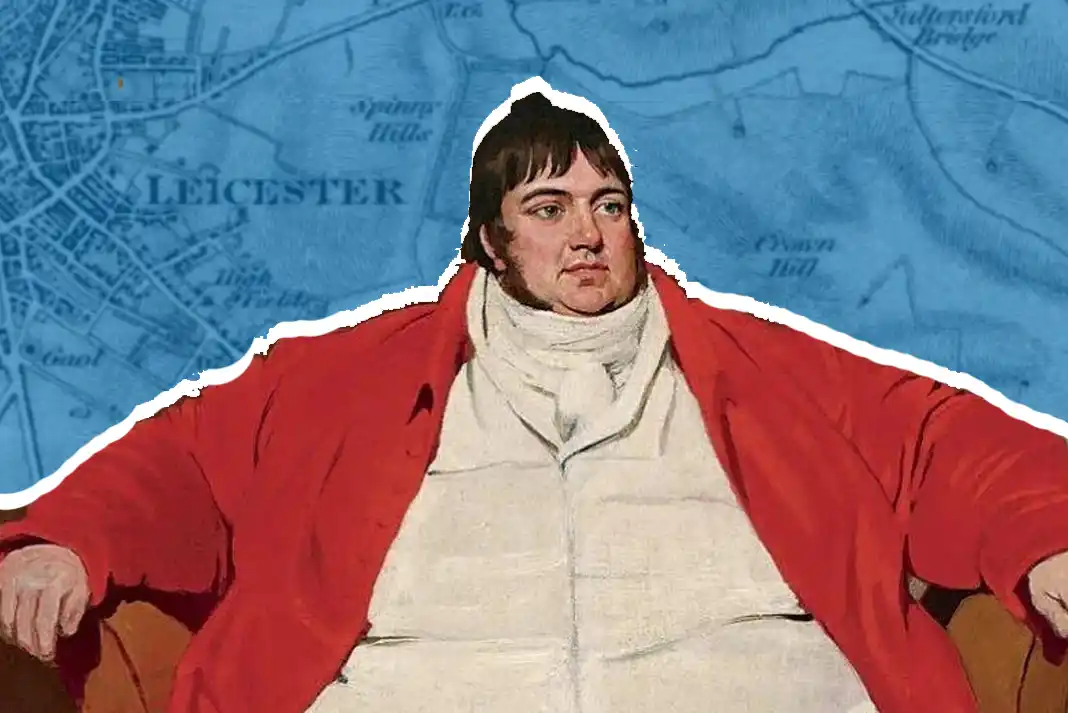
He was the Leicester giant who captured the hearts of a nation…
Long before social media created overnight sensations, Daniel Lambert captured the imagination of an entire nation. From the heart of Leicester emerged a man whose extraordinary huge physique made him one of Georgian Britain’s most talked‑about figures.
Born in Leicester on March 13, 1770, Daniel Lambert became internationally renowned for his remarkable size and widespread popularity. And by the time of his death in Stamford in 1809, aged just 39, he was one of the most well-known figures of his era — so much so that a waxwork of him later toured the USA.
A Leicester lad with an unusual destiny
Lambert didn’t actually begin life as an icon or a curiosity, his early years were quite normal.
Throughout his boyhood, Daniel was active, healthy, athletic – and slim. In fact, he was an excellent swimmer and from the age of eight and taught many other children to swim in the River Soar.
His family background also meant he was a keen rider, spending much of his time galloping around the rural landscape surrounding Leicester. The history books tell of a time when, whilst out riding one day, he came across a wild bear which he punched to the ground, causing her to roar out in pain and flee.
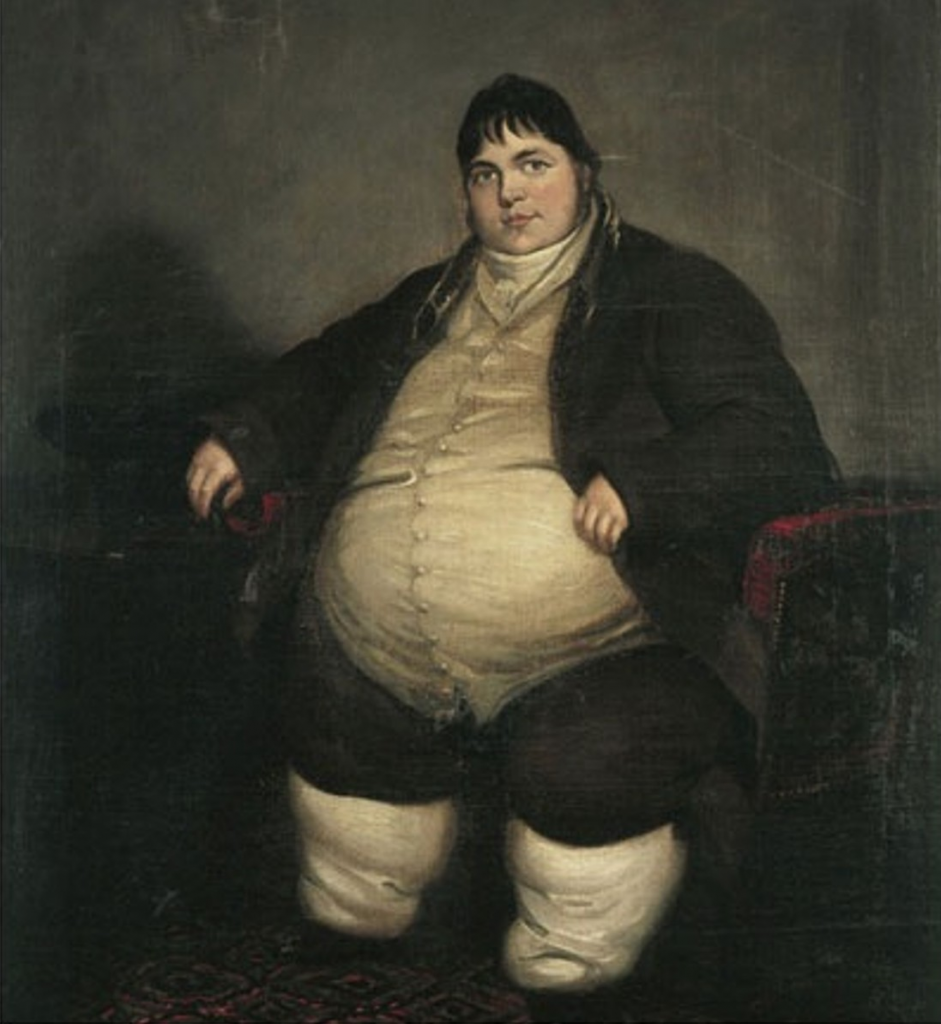
In 1791, at the age of 21, Daniel took over from his father as the Keeper of Leicester’s House of Correction on Highcross Street. Before long he’d earned himself a reputation as a benevolent jailer who took great care of his inmates’ welfare, introducing a raft of improvements to the city prison which won him the respect of those behind bars as well as prison reformers of the time. Visitors described him as courteous and composed; he was someone who commanded respect without ever raising his voice.
Although this was the making of his career, it may have been the undoing of his health. Despite not being a drinker or a big eater, within 11 years of taking up the job, Lambert tipped the scales at a whopping 32 stone, with his office job blamed for his huge weight gain.
He served faithfully at the prison until 1805, when a new jail was constructed and the Bridewell closed. Suddenly jobless—and with his size making conventional work impossible— Lambert faced the kind of crossroads that would have daunted most people.
But instead of retreating, he reinvented himself.
A celebrity on his own terms
At a time when individuals with unusual bodies were often exploited in travelling shows, Lambert took an entirely different approach: he chose to exhibit himself – but as a gentleman, not a spectacle.
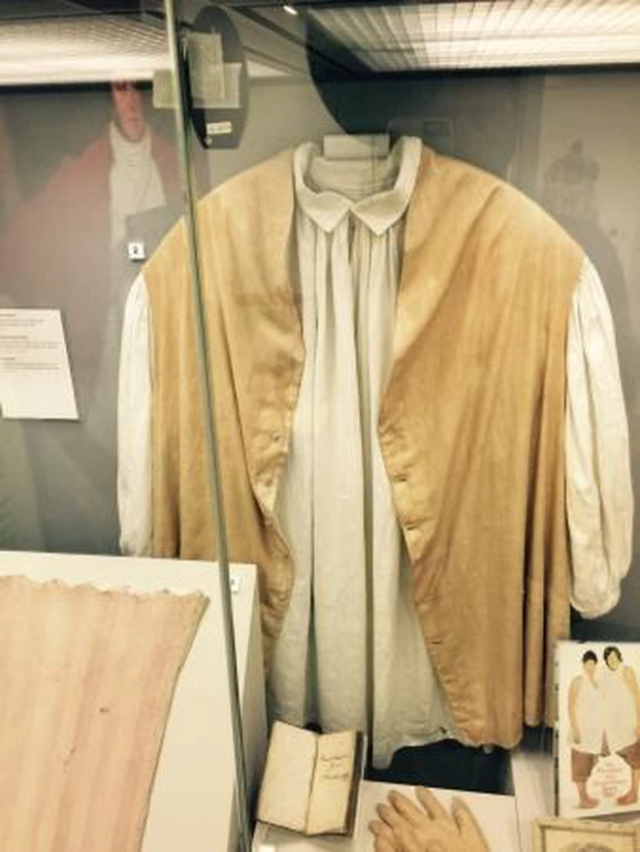
Arriving in London in 1806, he rented private rooms in Piccadilly and charged a small admission fee. No circus tent, no gasping crowds—just polite visitors welcomed into a well‑furnished parlour. Those who came expecting a sideshow curiosity instead met a gentle man of quick wit, broad knowledge, and warm conversation.
Artists sketched him. Aristocrats called on him. Newspapers praised his dignity. Lambert became something rare: a man whose physical distinction made him famous, but whose personality made him respected.
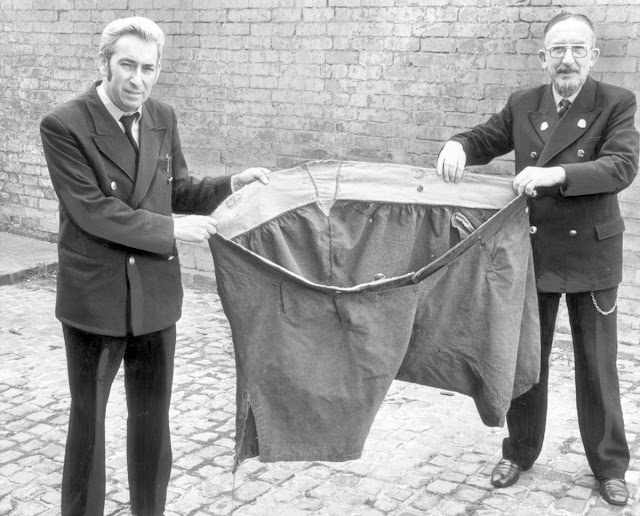
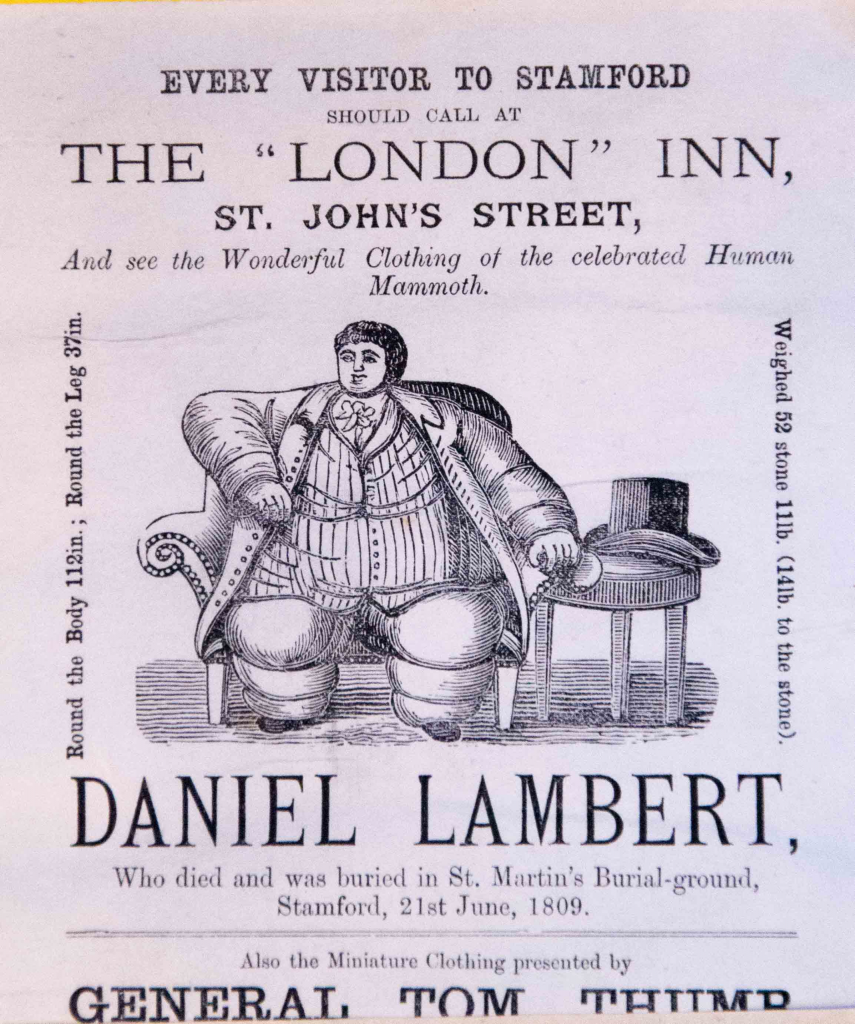
At his heaviest, he was believed to weigh around 52 stone (330 kg), but his agility and intelligence challenged the stereotypes of his age.
A sudden end in Stamford
After some months on public display in London, Lambert grew weary of exhibiting himself, and in September 1806, he returned, wealthy, to Leicester. He bred sporting dogs and regularly attended local sporting events. Between 1806 and 1809, he made a further series of short fundraising tours.
One account from the time suggests that his 1809 tour was intended to be his last, as he was then sufficiently wealthy to retire. While on the tour, Lambert was weighed in Ipswich; his weight was 52 stone 11 pounds (739 lb; 335 kg).
Upon arriving in Stamford in Lincolnshire, he announced he was no longer able to use stairs, and took lodgings on the ground floor of the Waggon & Horses inn at 47 High Street, Stamford in Lincolnshire on June 20.
It was there, in June 1809, that Lambert died suddenly at the age of 39. It was while taking a shave that he complained of breathing difficulties. Ten minutes later, he collapsed and died.
No autopsy was held and the cause of Lambert’s death is unknown, many, naturally, put it down to his weight, but witnesses say he had appeared well, before becoming short of breath and collapsing.
Experts continue to speculate but the explanation most agree on for the cause of death, given his symptoms and medical history, is that he had a sudden pulmonary embolism. These embolisms usually are the result of a blood clot in the leg that travels to the lung. The risk of these blood clots is usually increased by advanced age, cancer, prolonged bed rest and immobilisation.
Lambert’s corpse rapidly began to decompose so there was no chance of his body being returned to Leicester, so on June 22, it was placed inside an elm coffin that was built on wheels so it could be moved.
The window and wall of his apartment were demolished to allow the coffin to be moved out of the inn and to the newly opened burial ground at the rear of St Martin’s Church. A suitably sized grave had been dug, with a sloping approach to avoid the need to lower the coffin from above. On June 23, it took almost half an hour for twenty men to pull Lambert’s enormous coffin into the grave.
A legacy that keeps on growing
To this day, his gravestone remains one of Stamford’s most visited landmarks, its inscription a reminder of his extraordinary life…
Lambert’s friends paid for a large gravestone, inscribed:
In Remembrance of that Prodigy in Nature.
DANIEL LAMBERT.
a Native of Leicester:
who was possessed of an exalted and convivial Mind
and in personal Greatness had no Competitor
He measured three Feet one Inch round the Leg
nine Feet four Inches round the Body
and weighed
Fifty two Stone eleven Pounds!
He departed this Life on the 21st of June 1809
Aged 39 years
As a Testimony of Respect this Stone is erected by his Friends in Leicester
Daniel Lambert’s story has endured not because of his size, but because of the grace with which he met public attention. Leicester museums continue to display his portrait; pubs and businesses bear his name; and historians revisit his life as a symbol of bodily diversity and self‑determination.
He was a man who lived on his own terms, redefining what the world expected of him.
And perhaps that’s why, more than 200 years later, Daniel Lambert remains a legend—Leicester’s gentle giant whose character was every bit as remarkable as his stature.