Archaeologists digging ahead of the A46 Newark Bypass upgrade have uncovered some genuinely wild stuff — including seven ancient skeletons, a Roman well, and what look like Anglo‑Saxon houses, all buried just beneath fields locals have been walking past for years.
Before any actual construction starts, National Highways sent in a team to check what was underground — and it turns out Newark has been quietly sitting on history dating back as far as 6000BC.
Over 22 weeks, a crew of 30 archaeologists dug through five fields covering more than 23 acres, and what they found sounds less like roadwork prep and more like the plot of a Time Team reboot.
SIGN UP FOR OUR FREE E-MAIL NEWSLETTER SENT EVERY TUESDAY AND THURSDAY HERE
Skeletons next to the bypass? Completely normal apparently…
One field near the A46 revealed a burial site containing the remains of seven people, believed to date back to either the Iron Age, Roman or Anglo‑Saxon period. Scientists are now doing further tests to work out exactly when they’re from — but either way, they’ve been there a long time.
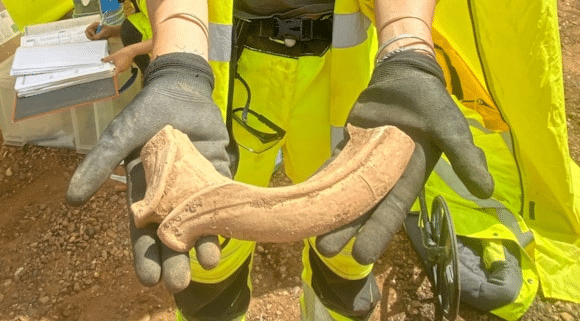
In the same area, archaeologists also uncovered the remains of a grubenhaus — an Anglo‑Saxon sunken‑floor house. These were once common in early settlements but are actually pretty rare in Nottinghamshire, which makes this find even more of a big deal.
Elsewhere, in a field near Kelham, the team found evidence of people living in the area across multiple eras — from the Mesolithic period all the way up to post‑Medieval times.
Finds included:
- A Roman enclosure
- The remains of a farmhouse
- A Roman well
- Arrowheads from prehistoric times
- A saddle quern used to grind flour in the Neolithic period
- And even items dating back to the English Civil War in 1642
Basically, people have never stopped living here — they’ve just been quietly leaving stuff behind for thousands of years.
National Highways project manager Naziya Sheikh said the discoveries were an exciting part of the early work on the scheme.
“These important pieces of history have unknowingly remained buried under Newark until now,” she said, adding that archaeology belongs to local communities and that care is being taken to preserve the finds.
Meanwhile, Sean Tiffin from Archaeological Management Solutions, who led the dig, said the discoveries offer new insight into the area’s past.
“Our excavations uncovered fascinating insights into life in this corner of Nottinghamshire — from prehistoric times right up to the present day,” he said.
So why were they digging in the first place?
All of this came about because of plans to upgrade the A46 Newark Bypass, which the Government confirmed in March as part of its third Road Investment Strategy.
The project aims to reduce congestion on a key Midlands route and will include the widening four miles of road between Farndon and Winthorpe and a new bridge over the A1.
For now, the finds have all been published online with photos and videos — and there are hopes some of the artefacts could eventually go on display in Newark, letting locals come face‑to‑face with the people who lived there thousands of years before traffic queues were the area’s biggest issue.