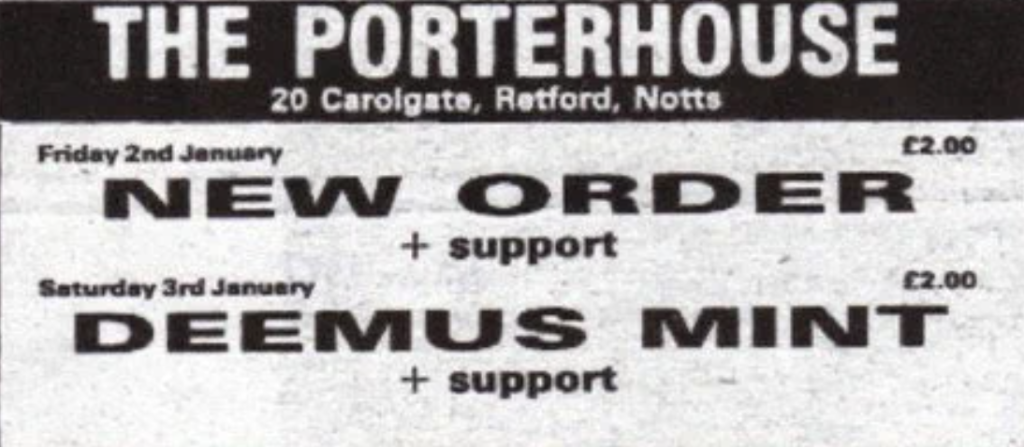
On a bitterly cold night in January 1981, a few dozen people drifted through the doors of The Porterhouse in Retford. The small club, squeezed between a parade of independent shops and a frost-covered car park on Carolgate, was hardly the setting for a defining moment in British music.
The posters were handwritten. The stage lights hummed. The air smelled of beer and damp coats. There was also a sense of curiosity. The band due to appear were familiar in one sense, but almost entirely unknown in another.
Their name was New Order.
Few in attendance could have realised they were watching a group at one of the most pivotal moments in its history. Less than a year after the death of Joy Division frontman Ian Curtis, Bernard Sumner, Peter Hook and Stephen Morris were attempting to build something new from the wreckage of one of Britain’s most influential post-punk bands. Joined by Gillian Gilbert, who had only recently become part of the line-up, they were still searching for an identity.
“We were still figuring out who we were,” Sumner later recalled.
“We had these new songs, but we didn’t know how they’d land. We didn’t even know how we felt about them yet.”
What followed on January 2, 1981, was one of the earliest and most revealing snapshots of New Order in transition – a band caught between grief and reinvention, carrying the weight of the past while taking tentative steps towards a very different future.
By the start of 1981, New Order had only recently adopted their new name and begun performing again. The future was uncertain. While they were determined to continue, they were equally determined not to become trapped by Joy Division’s legacy.
Retford proved an unlikely but important stop on that journey. Away from the expectations and scrutiny of Manchester and London, smaller venues offered the freedom to experiment. The band embarked on a run of intimate northern dates, using them as testing grounds for new material and a chance to refine their evolving sound.
The Porterhouse was the perfect venue for that process. A modest fixture on the early-1980s alternative circuit, it placed audiences close enough to catch every note, hesitation and breakthrough.
That evening, New Order shared the bill with fellow Factory Records act Crispy Ambulance, underlining the close-knit nature of the post-punk scene. Around 40 people paid just £2 each to see the show.
For Gilbert, who had joined only months earlier, the performance was another important step towards finding her place in the band.
The Setlist: A Blueprint for the Future
The Retford performance revealed just how quickly New Order were developing their own identity.
The set featured songs that would later appear on their debut album, Movement, released in November 1981:
- ICB
- In A Lonely Place
- Senses
- Mesh
- Dreams Never End
- Cries and Whispers
- Truth
- The Him
- Ceremony
Those who attended that night have since spoken of how remarkably complete many of the songs already sounded.
“Ceremony” – one of the final compositions written with Ian Curtis – served as the emotional centrepiece of the set, bridging the gap between Joy Division’s legacy and New Order’s future. Elsewhere, tracks such as “ICB” and “Senses” pointed towards a colder, more mechanical sound that retained the band’s post-punk roots while hinting at the electronic experimentation that would later define them.
Unofficial audience recordings capture a performance that is tense, atmospheric and often fragile. Sumner’s vocals are occasionally tentative but compelling, while Hook’s melodic basslines intertwine with Gilbert’s emerging keyboard textures to create something unmistakably new.
Hook later reflected on the significance of those early shows.
“We were playing differently,” he said. “Not consciously. It was just happening. Gillian was bringing in keyboards, and that changed the whole atmosphere.”
Gilbert remembers feeling nervous.
“But the songs were beautiful in their own way,” she said. “Fragile, I suppose. We were all fragile.”
One audience member, remembered only as Mark L, has never forgotten the performance.
“It felt like watching something being born,” he said. “They weren’t polished, but they were intense. ‘Ceremony’ especially – that one hit everyone in the chest.”
“Expectation was high for the old JD fans who really wanted the band to succeed,” remembers Neill Cordon, who was also at the gig.
“I can’t remember much about the tracks played on the night, as ever the gig was over before we knew it. However I remember coming away knowing I’d seen something special. 20 years on the new material is just as fresh.”
At the time, New Order’s appearance in Retford felt like just another small club gig. There was no media attention, no packed crowd and little indication of the influence the band would eventually have on music.
Looking back, however, the significance of the night is impossible to ignore.
The Porterhouse show captured one of New Order’s earliest fully formed performances, documenting the point at which they began moving decisively beyond Joy Division and towards a sound entirely their own. It marked one of the first clear glimpses of a band that would go on to reshape post-punk, synth-pop and electronic dance music.
For a few hours on a freezing January night, in front of barely 40 people, New Order began to sound like New Order.
“We didn’t know what we were becoming,” Sumner said.
“But we knew we had to keep going. That night was part of that.”