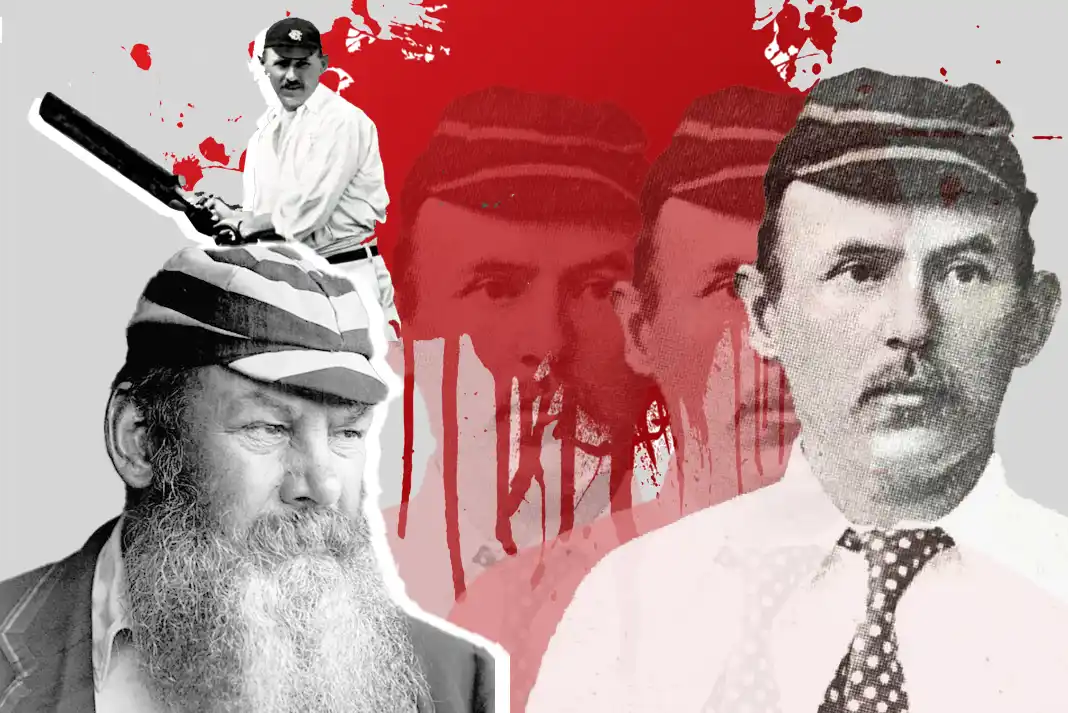

Cricketing great W.G Grace was famously once asked to name the player he’d pick first if ever selecting a side himself. “Give me Arthur,” he replied without hesitation.
The ‘Arthur’ Grace so hugely admired was Nottingham-born Arthur Shrewsbury – a mainstay of Nottinghamshire’s batting line-up for over two decades and made famous by becoming the first professional cricketer ever to score more than 1,000 runs.
But despite his monumental sporting achievements, Shrewsbury never managed to find true happiness during his life which was tragically cut short at the age of 47. Tortured by hypochondria and convinced he was suffering from an undiagnosed terminal illness, Shrewsbury put a gun to his head while staying with his sister and ended his life.
‘The best wielder of the willow in the world’
Arthur Shrewsbury was born on April 11, 1856, to parents William and Mary-Ann, in Willoughby Street, New Lenton – a part of Nottingham.
He was one of six children.

His interest in cricket seems to have stemmed from grandfather Joseph Shrewsbury, who played for the Beeston team in the 1820s.
Young Shrewsbury’s own club career began with a spell at Meadow Imperial. He then went on to play for Nottingham Commercial Club before being noticed by county officials and was signed up for Notts.
The Lentonian eventually made his County Cricket debut for Notts in 1875, aged 19. He got off to a flying start, ending his debut season with Notts on 313 runs at 17.38, with a top score of 41; in a season of wet weather he finished fourth in the county’s batting averages.
By 1885 Shrewsbury topped the batting averages in England for the first time and remained there till 1892, and was on top every year apart from 1888, which he did not play, and 1889 when he missed half the season. Only W.G Grace and Wally Hammond achieved such prolonged dominance over the English First-Class scene across such a lengthy period.
It was while on international duty that Shrewsbury became the first cricketer to score 1,000 test runs. He achieved this during Australia’s tour of England in 1893 during the First Test at Lords.
His scores of 66, 12 and 19 not out in the rest of the series helped England retain the Ashes that year. Shrewsbury was the leading run scorer in the series with 284 at 71.00.
As well as an outstanding runs total, Shrewsbury is also remembered for achieving the unique feat of scoring three Test centuries, all of which were against the old enemy Australia – two of them witnessed at Lords.
Fear of illness
In 1874, Shrewsbury had a bad attack of rheumatic fever and it was serious enough to keep him away from cricket.
Many biographers believe it was this sudden illness that triggered the hypochondria that would become all consuming in his later years.
Letters sent out just a few years before his death provide us with evidence that Shrewsbury remained convinced he wasn’t in the best of health, despite repeated assurances from doctors and medical experts.
In one letter, dated 1900, he seemed to suggest that while in good health, an underlying condition could be present: “I am pleased to say my health, as far as I know, is all right.”
Only weeks after sending the letter, Shrewsbury turned down the opportunity to play in a mid-April cricket match due to ‘fearing catching a cold or something worse’.
But it was in 1902 that Shrewsbury’s mental health really began to decline rapidly and his hypochondria really began to take hold. During the latter part of that year’s cricket season, Shrewsbury began to complain of pains in his kidneys. He had consulted various doctors and medical experts, but was constantly given a clean bill of health
Shrewsbury decided to take up residence in a London nursing home to undergo a series of medical tests but despite numerous examinations, no medic ever could find anything seriously wrong with him. This to made no difference to Shrewsbury, whose defiance soon turned to delusion becoming convinced doctors were all still missing something.
After leaving London, Shrewsbury returned to Nottingham in an exhausted mental state, prompting him make the decision to call time on his career.
He moved into the house of his sister Amelia Love, who owned The Limes, a house on Station Road in the Nottinghamshire village of Gedling.
It was on May 12th, 1903, that Shrewsbury ventured into Nottingham and purchased a revolver.
When he got home Shrewsbury discovered that he had purchased the wrong bullets for his gun and returned to the shop on May 19th to rectify his mistake. It was on that evening, after having requested that his girlfriend, Gertrude Scott, make some cocoa for him, he retired to his room early.
A few minutes later, Scott heard a rather strange noise coming from Arthur’s room upstairs.
She shouted upstairs asking what was it about.
“Nothing,’ he replied.
Arthur had just shot himself in the left side of his chest. Not sure if that was enough to cause death, he drew the trigger once again, this time placing the pistol to his right temple.
Death was instantaneous.
A tragic end for one of England’s finest batsmen.
The details surrounding his suicide came out at an iinquest held the following day. The coroner’s verdict was that Shrewsbury took his own life due to the mind being ‘quite unhinged’ by the belief that he had an incurable disease.
The coroner added ‘there was no evidence to show that he suffered from any major illness.
Girlfriend Gertrude Scott disclosed to the inquest that on the afternoon before his death, Shrewsbury had warned her, “I shall be in the churchyard before many more days are up.”
On the morning of May 20, the news of Arthur’s death reached the Notts cricket team. Their next game against Sussex at Hove, the scene of so many of Shrewsbury’s triumphs, was abandoned as a mark of respect.
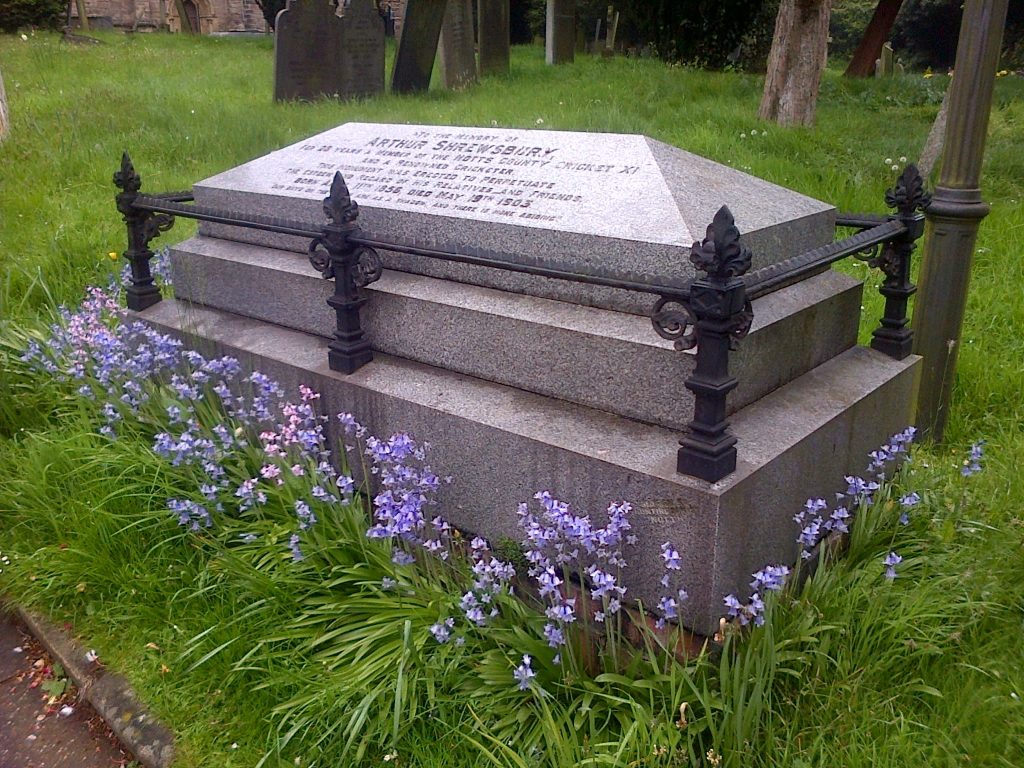
Arthur Shrewsbury was buried on May 21 in the churchyard of All Hallows Church, Gedling, his tomb facing the passing road, making it an easy spot for motorists.
We started sharing this tragic tale with a quote about Arthur Shrewsbury’s greatness from W.G Grace, so let’s end with one to reaffirm his status as one of the all-time greats.
“Arthur Shrewsbury must be acknowledged as the greatest professional batsman of his age. He has been a pillar of strength to his native county.”