Before footballers had agents, before influencers had ring lights and before anyone thought it was a sensible idea to wear gloves in a boxing match, Nottingham had William “Bendigo” Thompson. And frankly, he sounds like the sort of bloke who’d have been permanently barred from half the pubs in the East Midlands.
Born in a Nottingham slum in 1811, Bendigo arrived in the world with a name straight out of Sunday school. His middle name was Abednego, taken from a Biblical figure in the Book of Daniel, which somehow evolved into “Bendigo”, a nickname that ended up becoming famous on the other side of the world. Today, there’s even an Australian city called Bendigo, named in honour of the fighting legend from Nottingham. Not many people these days can say they punched their way into geography.
The People’s Champion
Bendigo wasn’t raised in luxury. After his father died, he spent a lot of his early years in the Nottingham workhouse, sold oysters on the streets and worked as an iron turner, building the strength that would later make grown men regret picking a fight with him.
By 18 he was already knocking over opponents in bare-knuckle bouts, and by his early twenties he was a professional prizefighter. But this was Victorian Britain. Fighters didn’t have medical checks and pay-per-view contracts, bouts could last for hours and participants generally looked like they’d just wandered out of a pub disagreement.
Standing just under 5ft 10in, Bendigo wasn’t the biggest heavyweight around, but he was crafty, quick and infuriatingly difficult to hit. Fighting southpaw, a stance in which the boxer has the right hand and the right foot forward, he built a reputation for winding up his opponents as much as beating them.
Boxing’s Original Showman
If social media had existed in the 1840s, Bendigo would have been unbearable. Some accounts describe him as part boxer, part comedian, part wind-up merchant.
He talked constantly during fights. He joked. He taunted. He danced around opponents. And then he punched them.
His greatest rivalry was with fellow Nottinghamshire giant Ben Caunt, a fearsome fighter who outweighed him significantly. The two men became Victorian sporting superstars, drawing enormous crowds for contests that gripped the nation.
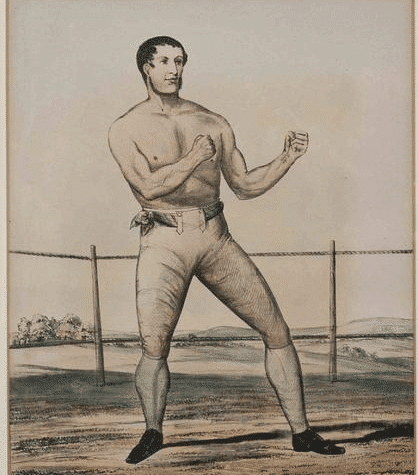
The two of them fought three times for the British championship. And they have gone down as the dirtiest, roughest, nastiest and bloodiest battles of all time.
After Caunt’s victory in the second contest, (Bendigo was awarded the first), the winner had to flee for his life as the Nottingham Lambs – the Mafia-like hooligans and ex-cons who supported Bendigo to see ‘fair play’ was done – set about the new champion with sticks and stakes.
The third meeting, after Caunt had plied his trade in America, was held at Lillingstone Level, Oxford in 1845. The location had been switched three times to avoid police detection.
A contemporary description of the bout still exists and decribes their savage encounter in detail: “Frequently Bendigo was tossed from the ring, Caunt trying to crash him on the ring stakes to break his back. Bendigo’s ‘Lambs’ attempted to bludgeon Caunt when within striking distance. It proved to be one of the most scandalous brawls in boxing history. Both men committed every known foul and invented a good many others.”
The fight sprawled 93 rounds (a round ended when one man was grounded by a genuine blow) with 10,000 looking on. It lasted two hours and ten minutes before Bendigo got the verdict, the referee disqualifying Caunt for allegedly going down without being hit.
In 1839, Bendigo defeated James “Deaf” Burke to become Champion of England, cementing his place as one of Britain’s biggest sporting icons. He would later reclaim the championship after another bruising chapter in his feud with Caunt.
A Life Lived at Full Volume
The problem with Bendigo was that he seemed to enjoy chaos and carnage almost as much as his boxing, which resulted in becoming acquainted with the Victorian authorities on a first-name basis.
Prizefighting itself was technically illegal, meaning arrests were almost an occupational hazard. Off the back of that came regular stories involving drinking, brawling and spells behind bars.
You get the impression that if trouble happened nearby, there was a reasonable chance Bendigo had either started it or sold tickets to it.
The Unexpected Plot Twist
Then something genuinely unexpected happened.
After years of fighting, drinking and generally behaving like Nottingham’s answer to a rock star several decades before rock stars existed, Bendigo found religion.
According to accounts from that time, while incarcerated he repeatedly listened to sermons delivered by the prison chaplain. One particular sermon stayed with him and eventually led him to attend a religious revival meeting after his release.
The fearsome bare-knuckle champion became an evangelist preacher and suddenly started touring Methodist chapels, delivering sermons and urging others to clean up their lives.
Bendigo died in Beeston on 23 August 1880 at the age of 68. It was reported he fell down the stairs and despite suffering a fractured rib and a punctured lung, clung to life for almost two months before unfortunately dying, still fighting till the end. Nottingham mourned the loss of one of its most colourful sons, and thousands are reported to have turned out for his funeral.
When Bendigo died in Beeston in August 1880, his final journey brought him back to Nottingham. His funeral cortege wound its way into the city before arriving at St Mary’s Burial Ground on Bath Street in St Ann’s, where thousands reportedly gathered to say farewell to the former champion. Even in death, “Old Bendy” could still pull a crowd.
Today, his grave remains in what is now known as St Mary’s Rest Garden. Tucked away amid the bustle of modern Nottingham, it marks the resting place of a man who rose from the city’s slums to leave behind a legacy behind that remains enormous.
Bendigo became one of the first true celebrity athletes Britain ever produced, was later inducted into both the International Boxing Hall of Fame and The Ring Hall of Fame, and remains arguably Nottingham’s most colourful sporting character.